
Natural Antibiotics
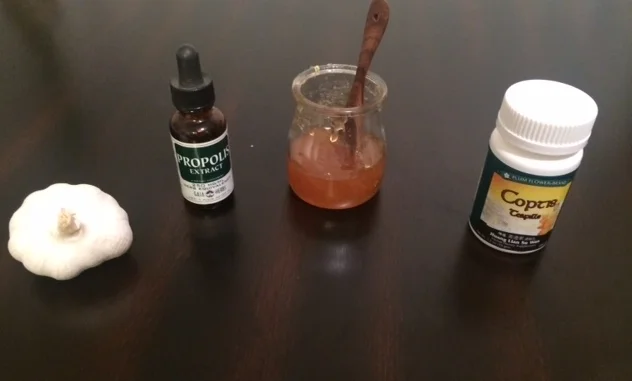
All right! Keeping on with the theme of colds and flus, this next entry will be on natural antibiotics. Some of these will be great in helping you combat those pesky sore throats and body aches, while others will be better at fighting skin eruptions and internal inflammation.
Garlic.
Okay, okay, I know that EVERYONE knows about Garlic and its potent antibiotic properties. It’s great for the beginning stages of colds and flus, great for any minor infections, wonderful at boosting the immunity, it has anti-cancerous properties, and anti-parasitic properties etc etc etc. Yawn. Garlic is just the boring typical superhero that kind of does it all. I won’t go into much detail here. But I will mention one thing. In order to get the antibiotic effect from garlic, one needs to either A) crush it before eating it or B) chew it really well before swallowing it. This is the case because the agent acting as an antibiotic in garlic is called Allicin. BUT this molecule doesn’t actually exist in raw uncrushed garlic.
Raw garlic has two other agents that react together to make allicin. It has Alliin and Allinase. These two compounds exist in different compartments of the herb. And the only way to get these to interact and create Allicin is to (like said earlier) A) crush it before eating it or B) chew it really well before swallowing it. And yes, bad news for ya’all who drink the garlic supplements instead because they are simply not potent enough for this very reason
A couple more noteworthy facts about garlic: black garlic (garlic that went through a type of fermentation) is actually stronger than regular garlic in antioxidants, although weaker in antibiotic properties. And sprouted garlic also has higher antioxidant levels than fresh garlic. So don’t throw out your garlic once the little green shoots appear!
For more info on garlic check this Weston Price article out:
http://articles.mercola.com/sites/articles/archive/2014/04/21/sprouted-black-garlic.aspx?x_cid=20140421_lead_facebookdoc&utm_source=facebookdoc&utm_medium=social&utm_content=lead&utm_campaign=20140421
Moving on.
Manuka Honey
Manuka Honey is honey that comes from New Zealand from bees that pollinate the Manuka bush, i.e. Tea Trees. Most of us know what tea tree oil is, right? Well this is the honey from those wonderful plants.
Interestingly, most honey, in general, is known to have antibiotic properties due to a compound known as Hydrogen Peroxide. Certain other honey also has methylglyoxal (MG), which is another compound with antibacterial actions. Now, Manuka Honey has both of these in much higher amounts than any other type of honey. PLUS it contains other compounds that are antibiotic in nature.
However, not all Manuka Honey is potent enough to work as an antibiotic. A special rating has been developed for Manuka Honey known as UMF (Unique Manuka Factor). One must buy Manuka Honey with the minimum rating of 10, but I would recommend 16. It must be Active Manuka Honey.
So, what is Manuka Honey good for? The most famous use for this honey is topically on wounds or ulcers. It is a proven topical antibiotic and also helps heal wounds faster. Certain hospitals even use it in treating MRSA (a power bug with antibiotic resistance).
I would add, however, that Manuka Honey could also be used in the beginning stages of a cold. It would go great with a warm cup of mint tea to sooth a sore throat. And in general, if there is an infection anywhere in the body, I would recommend to take Manuka Honey to help heal it faster.
Other problems that Manuka Honey is said to help: gastrointestinal issues, acne, diabetes, high cholesterol, and cancer.
For more info on Manuka Honey please visit this website: http://www.webmd.com/a-to-z-guides/manuka-honey-medicinal-uses
Propolis
Another magic product coming from bees. This is the material used by bees to help seal spaces in their hive, something like glue.
Propolis doesn’t only act as an antibiotic, but also as an anti-fungal and anti-viral. It is usually pretty hard to get in its natural form, although if you have connections to beekeepers they could definitely sell you some. Usually, propolis is sold as a supplement in coops or Whole Foods.
Again, one can use propolis in the beginning stages of a cold or flu to help fight the bug. There are even throat sprays to help target a sore throat directly. It is also HUGE in mouth care. Great for canker sores, cold sores, thrush, gingivitis, and post-op from mouth surgery. Other known uses: the infamous overgrowth of H. Pylori in the stomach, wounds, vaginitis and so much more.
Raw propolis could come in little hard dark rocks. If that’s the case and you want to use it for your mouth, you can just throw a piece in between your gum and cheek and leave it there for a while. Otherwise, you can buy a tincture and take it internally, or possibly dab it on the needed area.
Huang Lian (Rhizoma Coptidis)
Ah, back to Chinese herbs. There are many Chinese herbs with antibiotic properties. Huang Lian is just one of them, albeit a potent and popular one. So if someone is curious about the other numerous herbs that the Chinese Materia Medica has to offer, I would recommend two things: A) go to Acupuncture school or B) to save on time and money, buy Bensky’s Materia Medica, the official herbal textbook in Acupuncture schools.
Okay, so in Chinese Medicine, Huang Lian can be used for: gastrointestinal infections, high fevers, extremely painful sore throats, boils, abscesses, ulcerations and many many more infection-like issues.
It is rare to drink a single herb in Chinese Medicine for a problem. However, Huang Lian is one of those rarities. It is even made into a nice little concentrated pill produced by Plum Flower, and some other brands, and sold under the name: Huang Lian Su Wan (something you can buy on Amazon.) It is a nice natural antibiotic to have on hand for the beginning stages of any infection. And a great idea to take with you while traveling abroad, in case your adventures might lead to a questionable rash or stomach upset/infectious diarrhea.
I will caution you, however, Huang Lian could cause some loose stools for those of you with slightly weaker digestive systems (though you can actually take it for diarrhea caused by an intestinal infection – this is different from you constitutional loose stools). Also, please remember that if the infection is getting worse, it is time to drop the alternative route and check into a hospital, or at least go see a doctor.
And that does it for our Natural Antibiotic segment. Again, if there are any questions, please email me to let me know. Happy staying healthy!